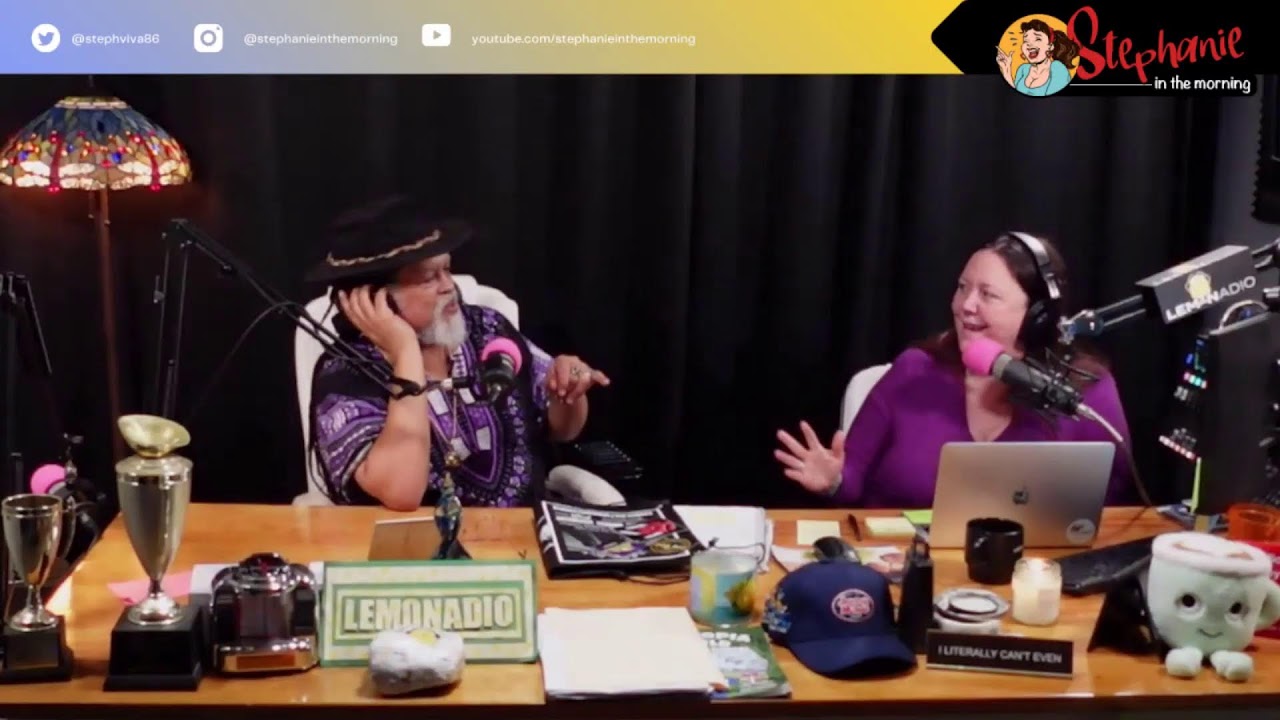
Polyphonic Studios visits us here at Lemonadio and schools us on the music magic that is happening with the GroovaLottos and all the solo projects that have been building up to one epic summer launch of some new vibes- get ready to be entertained!
Transcript
Made by machine from the recording, so a name or two may be off. About 6,224 words.
any minute now hi it's me alone at my desk we've got a previously taped show for you today I had the wondrous Joy of having def funky professor in the studio and while musicians morning time is not really the best time for them we recorded it so that we could share it with you during the morning show today so enjoy some new music and uh to find out what's going on with wiim the funky Professor here now let's see if this works all right we're going to add it saraphina and I were in a entrepreneurial book club where Stephanie never read the right book and Stephanie was terrible at this book I really suo at book club I did not fabulous I'm what I just had a visual I just had a visual I had a proud of it I love when we have special guests in the studio and I also love when we have special guests in the studio when I coordinating match with them it makes my day it's a purple kind of day the professor is back I'm so excited to have you back in the studio oh thanks for having me back on if you have not met this sinking piece of sunshine right here let me just introduce you to the professor wall I I feel like I need right oh all right oh all right now you see when when you make that noise it's supposed to like go into like a dance hole record supposed to come right after that sound is this what goes on in your brain all day every day pretty much honestly it's wonderful to sit here and have a dialogue before we go on the air I love our pre-organization because you get the real story you get to hear where the music kind of came from and I feel like within every part of your regular life you've just got this backtrack that you're making in the back beats of your brain and then you make it alive kind of that that is that is what happen it's wild so introduce yourselves as if you've never been here before Okay so my name is mim MIM the funky Professor I'm actually from mashby I should say of mashby because I did grow up in New York City but grew up in New York and mashby and uh so have a little bit of have that nice like mashby w that Bronx [ __ ] thing is I I love it it's flavor it's Mash B with flavor oh mashby has flavor I mean it does it's different yeah yeah yeah I feel like there's something about a New York flavor to things understood that is just a little wild it's like a little bit more it's it's got more Funk it's it's funny because I find there are more similarities than differences yep okay um in terms of well like what I have to I have to shout out the mash wampo rod and gunclub because those are the guys who taught me how to actually cook meat fish oh all right and how to season it properly okay and um yeah so Mash we got flavor well that's food that's different but there's all there's a style because I realized you know when um my mother first my mother first came here pretty much as like a tourist okay and mashby was the comfortable place and she'd be living in New York and mashby it was sort of like this is a very familiar the attitude the style very welcoming was very welcoming but was also just very familiar um the personality is the philosophy and you know because um in her case her family came from Barbados okay so you're dealing with an island culture so of course I guess is this why like you've got the Rihanna connection like is there something about Barbados that is just like amazing as far as music and culture and all I would say so I was because um it was my grandfather who came from Barbados was the one who taught me to play piano he started with a leg up I really appreciate that because I feel like when you come from a music background and it's inherently learned you know the bead of things oh yeah it's it's something that I don't think can be taught I think you just innate it yeah yeah it it I don't know um it's a little bit of Nature and nurture because like for example with um zigg I was a single parent from about the point he was 18 months old so he was in a house where there was an instrument in almost every room and he wasn't prevented from playing them playing with and you know violent playing with him yeah okay we stop that but I like that though you allowed him to like Wild Thing his way through music oh yeah oh yeah and when he was four my mother got him one of those um First Act drum kits for Christmas oh boy and I remember when he sat down to it he sat down picked up the sticks and I realized oh my God he's Keith Moon I love it though because and the crazy part was and it was funny because later gravitates to um a realize when I'm looking and I'm like um wh why why am I why why do I have CDs missing why my art Blakey CDs missing and when I'm looking for my art Blakey CDs all of a sudden I'm hear art Blakey coming out of his bedroom and you know he was like nine or 10 at the time and you can't be mad about it though like I'm annoyed that you touched my belongings however if that's the education you're giving yourself then get it that wasn't annoying that wasn't annoying at all it was surprising because you know you're thinking of niney olds going and you know you think of nine-year-old snagging your art ly CDs but I love that and and I feel like maybe that's that old soul that he has and that's why um I think for me it was the Beatles because that was what was available and you weren't finding an eight-year-old that was digging through like deep tracks of Beatles Cuts because I liked the way that they arranged music but this was it it was that same space that was available to him and that's where he got his yeah his roots for music this is the funny thing because my mother sang Opera but I reached past her Opera record for her Jimmy Smith jazz organ records and for her Billy Preston again R&B piano jazz type stuff and those were the records of hers that I'm like now sneaking into my collection and every day and getting into that kind of GrooVe so therefore you know it's sort of like the Next Generation I can't really get upset that yeah oh for sure you know that he's doing this so realizing that yeah there's a bit of a nature and a nurture um I um get into one of the forms of music I was doing was underground dance music house music uh-huh and when I couldn't really perform because again single dad with a little kid right um I started we not doing gigs so I started doing a lot of stuff with remixing and um one time because what I did was I set his little drum set up in the in the Attic Studio yeah and he'd play along and one time like that actually sounds pretty good so I put the mic on his drum kit put his headphones on I said okay when you hear the click just play along and so at the age of like eight he ended up on a house music record so that was UN his studio session look at this doting dad over here but you've also been making music right alongside him yeah yeah like I feel like that's also one of the things that you do best is constantly reinvent yourself change the flow change the style pick up new tricks a little bit or or it's some of it is more like on the Continuum side okay but it's funny because um well I realized one of my mentors um the late James spru he went from being my mentor to my collaborator and so that's the nature of that's the nature what that feeling like when that happens oh it's awesome like whoa you want my input okay it's awesome it's awesome and you know it's funny when you have collaborators that you came up together because um actor he's in holdovers he just um closed King Headley II and so cool about going to television um actor by the name of nahim Garcia he and I came up in the business together he's taking off in film and um he's in Black Mass actually and how long has he been at this he's been at this I mean as long as I we're going into like three four Decades of doing this and I think that that's so important to have this dialogue about music your intention when you're making it how you're putting it out there how your your career is going because I know it's frustrating for people that are just starting well people have to think of it in two different ways there's a business and there's an industry M if you're dealing with the industry that'll drive you crazy if you keep if you keep your mind about the business you'll be okay okay um and with that I suggest every two books that everybody should read I like this wisdom and homework uh one is a novel called Invisible Man the second one is a short story called The Man Who Lived underground by Richard Wright the novel is by um Ralph Ellison Invisible Man Ralph Ellison and and um the man who lived underground is by Richard Wright it's a short story obviously I can listen to this later but this is for me later also my writing and remembering the business mind allows you to stay outside the box okay because what it now is is more about a direct relationship with your audience or your customer or your fan base when Zig said he wanted to learn the music business okay great took his cocktail kit an amplifier and a bucket and let him go play out on the street honestly and and some people are like what kind of thing and I said no it's an education I I said no what you're learning is direct Market this is direct Market music business the guy who plays on the street I said I can tell you the guy who sits out on the street and plays with a bucket every day is making more money than the person with a record deal okay I don't know if that's true but h honestly I know that that person is definitely going to be connecting with people better okay well allow me to allow me to put it I hear it okay you get signed to a record deal right Y and now of course what they advertise in billboard magazine and cash boxes you got signed and you got half a million dollars well okay out of that half a million dollars you're going to be producing the record so you're going to pay all the producers out of that half a million dollars you're going to pay all the studio fees out of that half a million dollars any music videos you're going to make come out that half a million do now and of course if there's more than one person in the band then that all comes out of that half a millionar so now that half a million dollars has turned into about oh maybe 50,000 but the thing is that's now a 50,000 that you owe and you got to pay taxes on all of it yeah so yeah but but then that a lesson but the 50 Grand that's left is what you owe it's not it's not your 50 Grand until you make that back now the thing is yeah um yeah so so you want us to Market this record for you right well that's going to come out of that budget also right and by the way that's your salary for three years maybe maybe maybe five that that that's you know J and you're supposed to get like sometimes even two and three albums out of this half a million dollars and that half a million dollars got spent up on the first album so any other additional advance that they give you is now money that you owe right yeah so what happens is you make three albums you're not actually making a profit and that's possibly until that third album you know it's wild to me that this was not a discussion until Taylor Swift got stuck to it yeah yeah yeah yeah and then people were like oh wait a minute why but now let me explain this to you if I go in the studio and make a CD all right I that's money I spend out my pocket in fact um and nowadays you don't even have to do this but if you went that step say we're still back in 90s early 2000s so then I go and I print up a bunch of CDs money out my pocket right I take some of those CDs I hand them out to all the wonderful radio people who are going to play it all right well they play the CD I play my cards right I start doing open mics and I go and I sell the CD for $10 each people like me at the open mic they like the music I did so they buy my CD for 10 bucks well now it cost me $2 to make this CD I'm selling it for 10 that's eight bucks that I'm making back which basically means okay so look at what I spent Studio pressing up Etc let's say I spent $10,000 yep and I press up say 3,000 CDs and I sell them each for say 10 bucks 15 bucks depending on the gig y I've made back my investment with the first 200 CDs everything I everything I make beyond that 200 CDs is now a profit show me anybody signed to a major deal with a gold record who can say that yeah no none of them none of them so this is why I'm saying the business versus the industry yeah the industry makes you think you have to go huge and big the business helps you understand you know what I can stick to three states and make a living and this was the piece that I wanted him to understand and you know and it opens up a completely different uh mindset yeah well also and you're not making music to make music for that specific thing you're making music because you want to precisely and it's so very different when you're not well it you're making music because you want to and it's also you're not you're not sitting on Trends because like for example you think about your Taylor Swifts you think about your Shakira you think about they constantly have to think about the next Trend gotta pump it out the next big got do it and you know and one of the most disheartening things I remember was my little brush with the industry back in 2201 where I'm handed a production pack okay so you have to use these keyboard sounds this snare sound this kick sound and this bass sound and then when you listen to basically so weird to me but then when you listen to all the R&B records that came out in that time frame they all had the same drum sound right the same keyboard sound the same bass sound the same guitar sounds and it was because it was a production pack so it was sort of like the industry was controlling down to the particular sound of the drum yeah you know you think about for example Prince had a very distinctive snare when you listen to his records especially from like the mid 80s and so forth they would never allow that now yeah at least the industry would never allow that now it's kind of weird I equate it to when your kid likes a specific snack and then you like go when you get that snack and it's always That Snack until you buy a million of them and then your kid doesn't like that snack anymore and then they don't know what to do where's the next good stack coming from well well it's the funny thing the industry is about creating Trends and it always has been records were never meant to be collected records were supposed to be disposable the idea was we want to sell record players so to sell record players we're going to sell records okay all of your major record companies started out as Furniture companies I did not know that Colombia sold record players they manufactured record players RCA Victor manufactured the victrola the record okay yeah cuz it was Furniture yeah okay okay records and which which later became um MCA which later became I didn't even think about it like you know it's there but you didn't actually process that my brain well the thing is and then CBS is bought by Sony what did Sony make before they were Sony Music Sony made CD players okay what happened as soon as Sony bought CBS the CD became the new standard because Sony sold CD players interesting not turntables yeah it's wild and now we're in totally digital yeah which is lovely which and you have um Time Warner to think for that yeah well because Time Warner AOL and it now became a matter of okay but then it was this interesting struggle between Time Warner AOL and apple and apple was like well tell you what license your catalog to us and we can get it out to everybody it's what and like all of this happened in a span of how like not a lot of years I feel like this is it was it was a 12 year stretch yeah between it just completely changing the industry in and of itself up until 2015 the CD was still the broadcast standard but as soon as people said well you know what we have the 320 kilobyte MP3 that you can email to people didn't need CDs anymore right yeah Napster broke that for us stealing all the music and then they were like wait a minute what well this is this again us rich people need to sit on our heaps well well this again was perception because the issue with Napster and mp3.com was not you know what they said was oh people are stealing music look over here while we cause this Ruckus but what it was was mp3.com and Napster gave access to the independent artist to an international market correct because even if people weren't necessarily buying your CD on mp3.com they were listening to it and they were sharing it with their friends and they you know the same thing with Napster so what happened was I remember I was able to book my first tour back in 2000 off of mp3.com simply because I you you were heard I Was Heard and promoters were like okay he he has a good record and go out and do the shows yeah and um that was the piece that was upsetting about Napster in MP3 was that somebody was able to promote a record out of their living room in mashby I love but I love it those are the Stories We crave now yeah and it was that's the music we want now this is it this is it and it's nice to see this kind of turn over yeah and and the birth over here of poly Polytechnic Studios well polyphonic studiio polyic polyic stud swamp tronica you've got all this amazing alliteration in fact in fact let me say it commercial grade recording production mixing and mastering we do it all we even do remote recording polyphonic Studios you're going to love the way you sound ionic studios.com I love it homemade commercials right there for you from your basement in Mash P that's it oh no now we're now we're in warehous no I am in and our basement in Mash P okay yeah there we go there we go one one day I'm striving for a building like but you've had your your trials and tribulations and movement and you know what it's like to be in this industry and think you've got it and then you're like no no no that's not going to work for us anymore oh yeah got to go here oh yeah yeah yeah we we had our we had our studio in one place and we had a wonderful landlord then our wonderful landlord sold the building to a jerk so we moved to a different facility and now we have another wonderful landlord read the cranberry common this is life though I feel like of a musician you always have to like be ready to change and adapt it is it well yes and no okay um yes and no it it's the funny thing like ah we can get into the album Thunder child okay Thunder new album new album um this was change but not really adaptation per se okay it was U more I would say pushing my comfort level how so let's see for about 40 something years I couldn't figure out how to play a guitar really yeah and the funny thing is my first instrument was a string instrument I started out as a viola player but for some reason I could not translate that to playing a guitar and it took um Chuck V who's the chief engineer at polyphonic Studio really and quite the guitarist bass player and he said oh you think like a piano player so do this and within like a couple of months I'm actually playing chords now and figuring out tunes on a guitar isn't it wild how one person can just really change something that is like a glitch oh yeah oh yeah sometimes I mean he's an he's an excellent teacher um because I've seen him work with other people and you know what I can personally attest to wow he showed me how to figure this out and every now and again shows me something else and I didn't realize the guitar is a wonderful fidget toy because you can't sit and watch you can't like sit watch TV and play a piano and you can't really you know sit watch TV and sing but you can sit and watch TV and play the guitar just noodling yeah yeah and and you know it's so it's wonderful you know you get your add out and so forth running scales and running cords and changes and that kind of thing well doing that for a couple of years I found that okay I can actually now write songs on this thing that's funny my father-in-law is a guitar teacher and that's he He suggests to everyone yeah get on there and noodle yeah just play with it this is it this is it and that's what I was doing and then um just in terms of doing research and history one of the things that I started um doing was because I've always you reason I open a recording studio I've always been fascinated with sound and sound recording in the process and the error that I found one of the errors that I found most interesting was mid-60s when they first got into like multitrack in terms of like eight track 16 track recording because before that it was everybody's in the same room around the same mic and get it and and anybody messes up then you gota everybody has to start over again and then it came to three track where it gave you a little bit more flexibility that happened in the 50s and then um came for track and then from for track they figured out and oh by the way shout out a lot of people don't know this mtown actually had the very first eight trck recording system their engineer I did not know that their engineer built it really yeah he figured out how to sync together two fourt track machines very cool and so they had the first eight track system meanwhile in England I find out that what um Jimmy Hendricks and Company were doing they were going in recording in Fort track and then mixing that for track into another four track and then using the two empty track essentially making an eight track just like the hard way yeah yeah and and of course there's a little bit of sound quality loss yeah but just but just um listening to the records that were made during that time and that time period in the brill building and so forth and realizing this is when they're first introducing a lot of the um sound effects and so forth yeah cuz I Brian Wilson The Beach Boys was like really trying to orchestrate a lot of that stuff same kind of time period and and Phil Spectre just a little bit before of course Phil Spectre was still in the period when everybody's in the same room at the same time freako he ended up being but anyway I mean dangerous mine that one went just off the track not in any track I I'm trying to figure out somebody comes up with a concept called the wall of sound and we're gonna say oh I'm surprised he's a freak okay we all he screamed it from the towers I mean I mean okay I'm gonna say something very unpopular you have Amy wein housee and Kurt Cobain writing suicide letters and we instead turn them into platinum records it's wild and when they kill themselves we're like how did that happen I'm like maybe listen to their first album when they told you they were going to do it it's really you're listening to their most deeply disturbing things but people are telling you this is why like help me yeah right yeah cry for help but that's why brilliant but that's why because Brant let's put you on tour with drugs my God I know I know but honestly this is why we felt those albums because they are your soul yeah yeah like this is raw this is motion this is raw and now here we are like mixing and matching and playing with all of these sounds well there's a two ke to it we we um we embraced it because we related to it but we related to it because it was marketed to us that's true and that's the industry and that's the danger of the industry there any every and anything in the industry is disposable yeah so this is why the regard is not for the artist this is why you have one hit wonders MH because we're not dealing with the actual artist and the relationship between the artist and Their audience and um so you know with that this becomes the situ this goes back to why I said okay the sidewalk and the bucket or the gig or the now you're noodling on a guitar and I'm like I might do this on my next album but but the funny thing is noodling on the guitar and um just coming up with Tunes but then also like I said having an enjoyment of that sound of that the old records y the old Jazz records the old rock records the old punk rock records and so what I tried to do was make an album that was embedded in that old sound everybody can make stuff nice and Crystal Clean and Clear so I started listening mention Amy wi housee I was listening to the production process on her album because it had that old sound yep that Grammy yeah and and to like Leon Bridges love had that old dressed sound Y and just started listening to that listening to the old records and then the other piece that hit me was I started listening to well listening back I should say to a lot of 90s hip-hop producers okay because they were using those old records as the basis for their so listening to Like A Tribe Called Quest and Alish Shahed Muhammad listening to Pete Rock that was like bis Marquee's favorite thing was listening to all those old records and throwing those sounds back into the mix the music yeah yeah I was at a club with suddenly threw on the the um Sanford and Sun theme song he was an amazing DJ he was really quite incredible he played later part of his career he was playing DC mostly and you talk about like mixing sound and appreciating just the sound and the way it gets well changed up one of the other well two of the Geniuses in that regard like I'll go back specifically to Pete Rock and to um Rizza from wuang club and their respect for sound and um Alish Shahed Muhammad likewise his respect for sound and musicianship and so production wise I kind of used them as a basis but then started listening to the old records coming out of Memphis like pop Staples um Productions okay and the stuff coming out of stacks records and started saying okay and so the album kind of became an aesthetic question of because that's got to sound that's got to flavor all EX different exactly exactly and and so what I the the question I asked myself problem when me become academic it always has to be based on the question and so the question I said was what if Pete Rock and Rizza collaborated with Jimmy Hendrick and Muddy Waters on a record and this album was my answer okay so what would it what track of the ones that are out there right now that you think we can play right now that kind of let's let let's hit him with um huh okay the one that answers the uh Rizza Muddy Waters question let's hit him with a party at the crossroads okay a I love it I to the Crossroad hoping to find the answer from a wise old man a VI like Su had three rings on his hand he wor a threeie su had three rings on his hand don't me sit on down and that's where it all begin and there r no to there's something about that right there whatever reason was feeling Tracy Chapman in there almost I really so good so talk to me about that what was different about that for you um again it's all guitar based it's no keyboard and it's not not Jazz I'm out here with a new instrument y'all yeah and playing like lead lines and stuff like that so that that was completely different for me I love the feel of that thank you thank you and um blue like I said I'm know more for jazz and like house music and stuff like that so doing a record like that is a departure for sure and it's just like super viby and it's just got that southern Wing I feel like I don't know well there's another piece to it um with a party at the Crossroad I what I wanted to do was decolonize a folk taale okay um there's always a story about Robert Johnson who met the devil at the Crossroad okay and what bothered me about that is the quote unquote devil at the Crossroad was actually a deity from West African from the West afri panth okay um in Nigeria particular the eura people have a deity named allea who's a trickster and his and he dwells at the Crossroad and he is the one who figures out based on your karma your destiny he sends you down the right or the wrong path but it's based on who you are and of course what happens um as we come here the notion is that anything that's not Christian is demonic yeah well so what they did was they turned this deity into he's the devil so I was I let me retell the story what if he actually then just met a li with the crossroad and got a guitar lesson The Devil Went Down to Georgia has a different Spin and so because when you when you listen to Robert Johnson the crossroad Blues yep that's kind of the story he's alluding to and that's what it always became oh he met the devil it's like no no he didn't no he didn't and um you know the he made himself in the mirror and made some choices yeah and you know the thing with um now the funny thing with with Charlie Daniels that's a completely different yeah he probably did meet the devil that's a different man alog together this is it this is it yeah so what is each track is a little bit different on this a little bit they were all like I said they all I gave them all that retro feel I loved it as soon as I started listening um specifically to I think it was awaken aw that's what's want to hear sunlight streams around the window shade my eyes open and Clos to a squint rise to a day with morning gone reminiscent of how last night was spent waking up to a clouded memory and opening up to a master plan all I need is a few more minutes cuz this is how the day began I was awaken by a noon day Sun yours light of the time awen by no day sun and I will go till the sun rises the next day now for this one I'm just like it's got It's a melted pot of goodness black tiles s shars up my legs sending me right into the Pres out the only together 2:00 found me over here equality know awaken by a noon day sun light of sh a by day sun and I will go to theit wrote it down first my I heard it was like W by is like current like you know wiess in that infusion of that sound that she loves and then mix so really a very old viyana yeah I'll beat you at the club later I'll even put you on the list and when you wake up on Sunday afternoon it's just sound really want day light of the time yeah I I love it by oh yeah I might have it what I did with this version I won't be able to get it there but CG me this storylight stream around the window shade my eyes open and closed to a squint rise to a day with morning absolutely all right well thank you to the funky Professor I don't know why his music just continues to play over him uh Professor wiim I really appreciate it you can find him pretty much at polyphonic Studio definitely go check them out they've got gigs May June they've got tons of new music coming and we're really excited for that you will be seeing them at the mash B Farmers Market they're definitely going to be playing we're working on a show right now now uh have a great week everybody I have oh Marty bremel from the greater High inest chamber on the show with us on Friday Hank will be back in the studio with me tomorrow if you want to join us ever and you've got some new music you've got something fun you've got a business idea or you're just doing your thing and you want to host a Morning Show please reach out to us send us an email and uh we'll talk soon happy Wednesday everybody Brooke is going to be over at k-pod beard tonight you want to play some music Bingo she'll be there from 6:00 until 8 we'll talk to you later have a good one bye